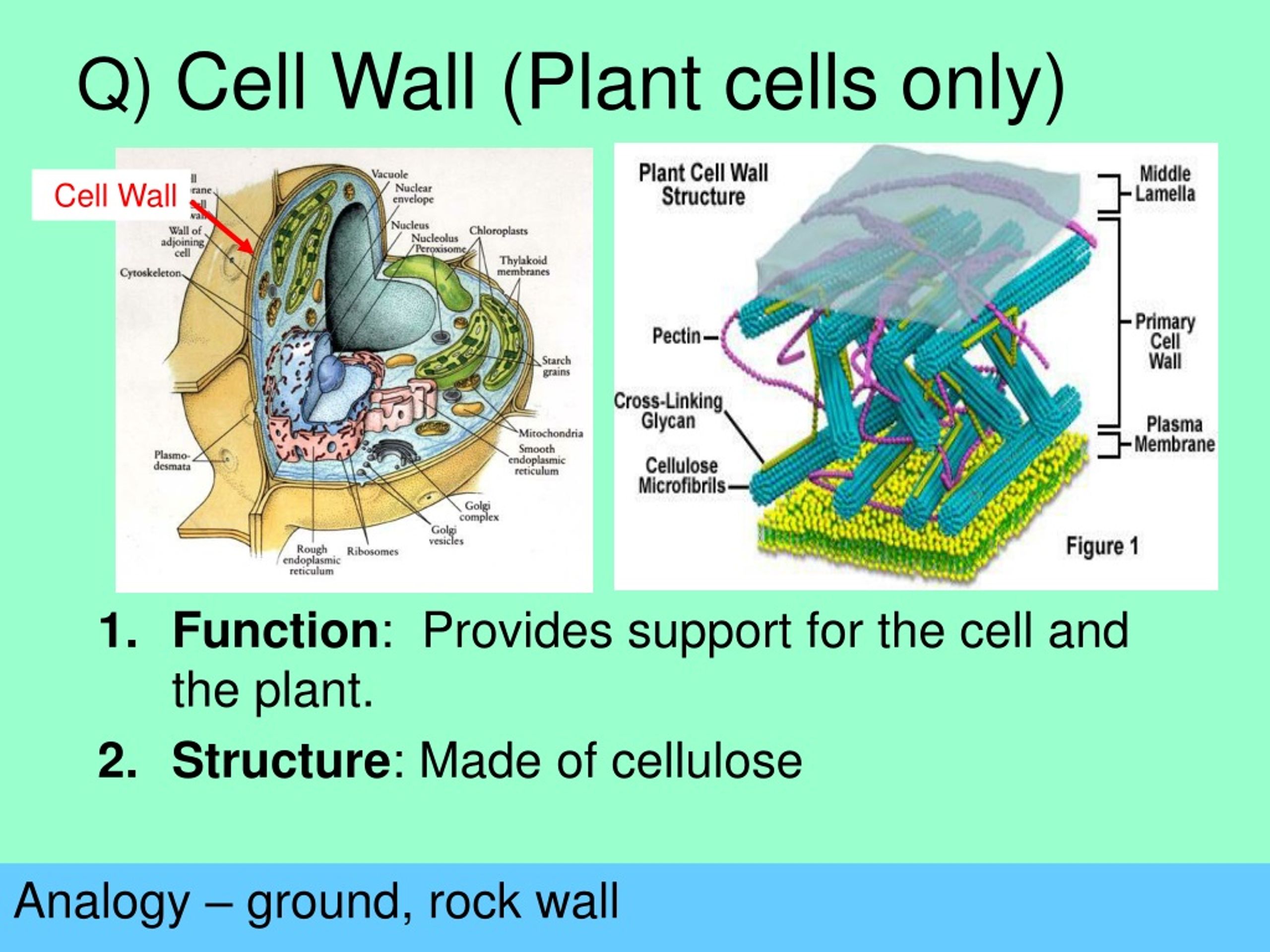

Understanding the complexities of biologic systems often requires the use of analogies to simplify and elucidate intricate concepts. One such analogy that has proven invaluable in the study of biology is the Cell Wall Analogy. This analogy helps to illuminate the construction and office of the cell wall, a critical component of plant cells and many prokaryotic cells. By drawing parallels between the cell wall and familiar structures, we can gain a deeper realise of its role in preserve cellular unity and ease essential biological processes.
What is the Cell Wall?
The cell wall is a rigid layer that surrounds the plasma membrane of plant cells, bacteria, fungi, and some protists. It provides structural endorse, protection, and helps maintain the cell's shape. Unlike animal cells, which have a flexible plasma membrane, plant cells have a cell wall that gives them a more rigid structure. This inflexibility is crucial for the plant's ability to grow upright and withstand environmental stresses.
The Cell Wall Analogy: A Structural Perspective
The Cell Wall Analogy frequently compares the cell wall to a brick wall. Just as a brick wall is composed of individual bricks held together by mortar, the cell wall is made up of various components that work together to render strength and support. In plant cells, the primary components of the cell wall are cellulose, hemicellulose, pectin, and lignin. These components are stage in a complex matrix that gives the cell wall its structural integrity.
To further illustrate this analogy, study the following breakdown:
| Cell Wall Component | Brick Wall Equivalent | Function |
|---|---|---|
| Cellulose | Bricks | Provides structural endorse and inflexibility |
| Hemicellulose | Mortar | Binds cellulose fibers together |
| Pectin | Mortar | Helps in cell bond and flexibility |
| Lignin | Reinforcement bars | Adds strength and inflexibility, especially in woody plants |
This analogy helps to visualize how the different components of the cell wall work together to create a strong, supportive structure. Just as a brick wall would crumble without mortar, the cell wall would lose its integrity without the binding properties of hemicellulose and pectin.
The Cell Wall Analogy: A Functional Perspective
Beyond its structural role, the cell wall also plays a crucial functional role in the cell. It acts as a barrier, protecting the cell from international threats and regulate the movement of substances in and out of the cell. This functional aspect can be compared to a fortress wall, which not only provides structural indorse but also serves as a defensive barrier.
In the context of the Cell Wall Analogy, the cell wall can be seen as a fortress wall with various key features:
- Defensive Barrier: Just as a fortress wall protects the inhabitants from external threats, the cell wall protects the cell from physical damage and pathogens.
- Selective Permeability: The cell wall allows certain substances to pass through while blocking others, similar to how a fortress wall has gates and watchtowers to control entry and exit.
- Communication and Signaling: The cell wall is involve in cell to cell communication and bespeak, much like how a fortress wall might have signal towers to convey with other fortifications.
These functional aspects highlight the importance of the cell wall in keep cellular health and ease crucial biologic processes.
The Cell Wall Analogy in Different Organisms
The Cell Wall Analogy is not limited to plant cells; it can also be apply to other organisms with cell walls, such as bacteria and fungi. In bacteria, the cell wall is primarily pen of peptidoglycan, a polymer of sugars and amino acids. This construction provides rigidity and protection, much like the brick wall analogy. In fungi, the cell wall is made of chitin, a polysaccharide that gives the cell wall its strength and tractability.
For bacteria, the cell wall can be compare to a suit of armor, providing protection and structural support. The peptidoglycan layer acts as a rigid exoskeleton, allowing the bacterium to preserve its shape and withstand environmental pressures. In fungi, the cell wall can be equate to a pliant yet strong scaffold, provide both support and protection while allowing for growth and expansion.
Note: The composition and structure of the cell wall can vary importantly between different organisms, but the underlying principles of support, protection, and rule remain consistent.
The Cell Wall Analogy in Plant Growth and Development
The Cell Wall Analogy is particularly relevant in understand plant growth and development. As plants turn, their cells must expand and divide, a operation that requires the cell wall to be both pliant and strong. The cell wall's power to stretch and expand is crucial for plant growth, allowing cells to increase in size without losing their structural integrity.
During cell part, the cell wall plays a critical role in ensuring that the girl cells are properly separated and maintained. The cell wall's components, such as pectin and hemicellulose, help to bind the girl cells together, ascertain that they remain join and functional. This operation is analogous to the construction of a new wall within an exist fortress, where the new wall must be mix seamlessly with the old structure.
besides its role in cell division, the cell wall also plays a all-important role in plant defense mechanisms. The cell wall's inflexibility and strength make it an efficient roadblock against pathogens and pests, protect the plant from infection and damage. This defensive role is analogous to the fortress wall's power to withstand attacks and protect its inhabitants.
The Cell Wall Analogy in Biotechnology and Agriculture
The Cell Wall Analogy has hardheaded applications in biotechnology and agriculture. Understanding the structure and function of the cell wall can aid in acquire new technologies and techniques for improving plant growth, disease resistance, and crop yields. for instance, researchers can use the cell wall analogy to design new materials and methods for enhancing plant cell walls, create them stronger and more resistant to environmental stresses.
In biotechnology, the cell wall analogy can be used to acquire new biopolymers and biomaterials with applications in medicine, mastermind, and environmental science. By canvas the cell wall's components and their interactions, researchers can create new materials with alone properties, such as high strength, flexibility, and biocompatibility.
In farming, the cell wall analogy can be used to develop new strategies for ameliorate crop yields and disease resistance. By interpret how the cell wall contributes to plant growth and defense, farmers can apply practices that enhance the cell wall's strength and flexibility, stellar to healthier and more generative crops.
For illustration, the use of cell wall degrade enzymes in biotechnology can aid in break down plant materials for biofuel production. These enzymes target specific components of the cell wall, such as cellulose and hemicellulose, create it easier to extract sugars and other valuable compounds. This process is analogous to dismantling a brick wall to access the materials within, highlight the practical applications of the cell wall analogy in biotechnology.
Additionally, the cell wall analogy can be used to acquire new methods for check plant diseases. By translate how pathogens interact with the cell wall, researchers can design new treatments that heighten the cell wall's justificative properties, making it more resistant to infection. This approach is analogous to reinforce a fortress wall to punter withstand attacks, spotlight the virtual applications of the cell wall analogy in agriculture.
In summary, the Cell Wall Analogy provides a valuable framework for understanding the structure and function of the cell wall in various organisms. By drawing parallels between the cell wall and familiar structures, we can gain a deeper understanding of its role in conserve cellular integrity and facilitating all-important biologic processes. This analogy has practical applications in biotechnology and usda, assist to germinate new technologies and techniques for improving plant growth, disease impedance, and crop yields.
Moreover, the cell wall analogy can be extended to other biologic structures and systems, providing a versatile tool for understanding complex biologic phenomena. By utilize this analogy to different contexts, we can gain new insights into the structure and use of biologic systems, preeminent to advancements in various fields of skill and engineering.
to summarize, the Cell Wall Analogy is a powerful instrument for realise the complexities of biological systems. By drawing parallels between the cell wall and familiar structures, we can gain a deeper see of its role in maintaining cellular integrity and facilitating all-important biologic processes. This analogy has hardheaded applications in biotechnology and agriculture, helping to acquire new technologies and techniques for improving plant growth, disease resistance, and crop yields. By extending this analogy to other biologic structures and systems, we can gain new insights into the construction and function of biological systems, starring to advancements in assorted fields of skill and engineering.